
Last updated October 30, 2026
 Home additions & ADU
 Kitchen remodeling
 Bathroom remodeling
 Roofing
 Windows & doors
 Driveway & pavers
 Fence
Free written scope consultation - allowances, timeline, and change-order rules on paper before a single trade is scheduled
Construction Warning Signs: A Tustin Homeowner’s Reference Guide
Most construction warning signs aren’t dramatic failures. They’re quiet signals in specific materials and systems that homeowners walk past daily without recognizing what’s being communicated. A hairline crack in your stucco isn’t automatically a structural problem, but a hairline crack in a specific location on a post-tension slab foundation almost always is. Knowing the difference is worth thousands of dollars in avoided emergency repair costs. This guide covers what to look for room by room, how to triage what you find, and when a Tustin homeowner should call a general contractor versus a foundation specialist.
Quick Answer
The most serious construction warning signs in Tustin homes are diagonal cracks wider than 1/8 inch near door and window corners, moisture staining on stucco that follows a vertical crack path, lifted or cracked tile roof ridges visible from the ground, and any burning smell near outlets in homes built between 1965 and 1975 with aluminum wiring. Most other warning signs are cosmetic or maintenance-related and can wait. If you spot any of those four, get a professional assessment before the next rain.
Styles & brands we work with
Table of Contents
- Foundation Warning Signs: Post-Tension Slabs and Stucco Cracking
- Stucco Exterior Warning Signs: Cosmetic vs. Moisture Intrusion
- Roof Warning Signs on Tustin’s Flat and Low-Slope Tile Roofs
- Window and Door Alignment: Foundation Movement vs. Seasonal Expansion
- Electrical Warning Signs in 1960s – 1980s Tustin Housing Stock
- Plumbing Warning Signs: Galvanized Pipes and Hidden Leaks
- Room-by-Room Visual Inspection Guide
- Common Mistakes to Avoid
- When to Call a Professional
- Frequently Asked Questions
- The Bottom Line
Foundation Warning Signs: Post-Tension Slabs and Stucco Cracking
Tustin’s housing stock sits overwhelmingly on post-tension concrete slab foundations. These slabs contain steel cables tensioned after the concrete cures, which lets the slab flex slightly under soil movement without failing. That’s good news in Orange County, where expansive clay soils swell with winter rain and shrink through summer drought. But it also means the cracking patterns you see on your exterior walls follow predictable rules.
A diagonal crack running from the corner of a door or window frame outward at a 45-degree angle is the classic post-tension slab warning sign. In Tustin’s older tracts, especially around Tustin Meadows and the neighborhoods east of Red Hill Avenue, these cracks typically appear within the first five to seven years after construction and stabilize. The concern is when a diagonal crack exceeds 1/8 inch in width or continues widening season after season.
Here’s what we’ve seen in hundreds of general contractor site visits in Tustin:
- Hairline vertical cracks in stucco (under 1/16 inch): Normal curing and settling. Monitor annually. No action needed.
- Diagonal cracks at door corners under 1/8 inch: Common on post-tension slabs. Monitor. Fill and repaint if they bother you visually.
- Diagonal cracks over 1/8 inch or actively widening: Call a foundation specialist. The slab may be experiencing differential settlement. A general contractor can coordinate the repair scope, but the structural assessment needs a foundation engineer.
- Horizontal cracks in stucco with displacement: This is the rarest but most serious sign. It indicates lateral force, which on a slab foundation usually means soil pressure or a failing retaining wall. Do not ignore it.
- Interior drywall cracks that follow the same pattern as exterior stucco cracks: This confirms the movement runs through the building envelope, not just the surface finish.
Tustin’s soil conditions vary by neighborhood. Homes in the Tustin Legacy and Columbus Square areas sit on engineered fill that tends to perform well, while older homes in unincorporated areas and shaded hillside lots can see more seasonal movement. The key variable is moisture: when Tustin’s clay soil gets a full winter saturation cycle after a long dry stretch, that’s when shifting happens and cracks show up.
Stucco Exterior Warning Signs: Cosmetic vs. Moisture Intrusion
Stucco is the dominant exterior finish on Tustin homes, and it’s a material that hides its problems well. Most hairline cracking in stucco is cosmetic and has no consequence beyond appearance. But a specific subset of stucco cracks actively channels water into the wall cavity, where it rots sheathing, breeds mold, and slowly destroys the framing behind your walls. The difference comes down to crack geometry and location.
The rule we give every Tustin client: a crack that runs vertically through a stucco wall and connects to a horizontal surface above is a moisture pathway. Water running down the wall gathers at any horizontal ledge – a window sill, a door header, a change in wall plane – and follows the vertical crack into the wall. In Tustin’s climate, with our concentrated winter rain events, one season of neglect on one of these cracks is enough to start the rot process.
- Look at the full wall plane, not just the crack. Walk the perimeter of your home and photograph every crack you find, wide shot and close-up. You’re looking for pattern, not just individual flaws.
- Identify the source of water above the crack. Is there a roof edge, gutter run, window, or horizontal trim band above the crack? If yes, the crack is a moisture pathway. If no, it’s likely surface-level and cosmetic.
- Check for efflorescence. A white, chalky residue along the crack edges means water has already moved through the wall. That’s mineral deposits left behind after moisture evaporated. It’s proof of an active intrusion pathway, not speculation.
- Probe the area gently. Press with a screwdriver handle around the crack. Soft, spongy, or crumbling stucco means the moisture has reached the framing. Solid resistance means the wall cavity may still be dry.
- Mark and monitor. Draw a pencil line at the end of each crack and date it. Recheck after the next rain. If the crack hasn’t extended past the line in six to twelve months, it’s likely dormant.
When we take on a home remodeling project in Tustin, stucco repair before repainting is one of the most common scope items we add after a property assessment. The hidden moisture damage we uncover behind what looked like a hairline crack on the surface drives more repair cost than most other single item on an older home.
Roof Warning Signs on Tustin’s Flat and Low-Slope Tile Roofs
Tustin has an unusually high concentration of flat and low-slope roofs, particularly in the mid-century tracts built through the 1960s and 1970s around Old Town and the area west of the 55 freeway. These roofs use concrete or clay tile on slopes and built-up or modified bitumen membranes on flat sections. The warning signs are different from pitched comp-shingle roofs and they’re often invisible from the ground.
The most underrated roof warning sign in Tustin is a lifted tile edge that hasn’t cracked yet. A tile that lifts even a quarter inch breaks the channels that direct water down the roof plane. Water then runs sideways under the tile field, finds the underlayment, and starts working its way through the paper. By the time you see water staining on your ceiling, the underlayment has been failing for months or years.
- Lifted or displaced tiles: Visible from the ground as a tile sitting higher than its neighbors or shifted sideways. Any lifted tile is an active leak risk in the next extended rain.
- Cracked mortar ridges: The mortar packed along hips and ridges on Tustin tile roofs absorbs water movement and expands. Cracks here let water into the ridge line, where it runs under the tile and finds the underlayment. Mortar ridge repair is a maintenance item every 10 – 15 years.
- Flashing failures at roof penetrations: Pipes, vents, skylights, and HVAC penetrations. On flat roofs, these connections are the single most common leak source. The flashing rusts, the sealant degrades, and water follows the pipe into the attic. Ground-level inspection won’t catch this – you need eyes on the roof plane.
- Dark staining on vertical wall intersections: Where the roof meets an upper wall, water can wick behind the stucco and travel downward. Staining at these intersections on a Tustin tile roof usually means a failed headwall flashing, not an interior plumbing leak.
- Missing granules or exposed mesh on flat sections: Flat membrane roofs wear out from UV exposure, and Tustin gets plenty of sun. A roof that looks dry and checkered from ground level has likely exhausted its protective coating and is nearing end of life.
When we specify roofing on remodeling projects, we work with GAF, CertainTeed, and Owens Corning systems exclusively. A roofing system from one of those manufacturers carries material warranties that no contractor can provide on a patch job. If your Tustin roof shows any of the warning signs above, the question isn’t whether to repair – it’s whether the remaining roof life justifies more patches or whether a reroof is the smarter spend.
Window and Door Alignment: Foundation Movement vs. Seasonal Expansion
A door that sticks in August and swings freely in January is not a foundation problem. That’s seasonal wood expansion, and every Tustin homeowner will experience it at some point. The distinction matters because one answer costs nothing and the other can run into five figures.
Wood swells with humidity and shrinks with dryness. Tustin’s winter humidity and summer Santa Ana conditions create a wider seasonal swing than most California markets. Solid wood doors and wood-framed windows expand noticeably during our wetter months and bind against their frames. This is normal, predictable, and resolves itself when conditions shift.
Foundation movement produces different symptoms entirely:
- Persistent misalignment that doesn’t change with the season: If a door sticks every month of the year, the opening has changed permanently. Foundation is the prime suspect.
- Gaps that open and close diagonally: A door that’s tight at the top latch side and gapped at the bottom latch side indicates the frame has racked out of square. That’s structural movement, not wood breathing.
- Windows that crack glass even when closed: A window that fits properly but develops stress cracks along the glass edge is under frame pressure. The frame is moving, and the glass is the canary.
- Cabinets pulling away from walls: Upper cabinets separating from the wall plane by more than a cosmetic caulk gap is a classic sign of slab movement traveling through the structure.
- Baseboards separating from the floor: Small seasonal gaps are normal in Tustin. A gap that’s larger than 1/4 inch year-round signals movement below the wall.
If you’re seeing window or door alignment changes and you’re planning a home renovation in Tustin, address the diagnosis before the remodel. Cosmetic fixes applied over structural movement fail quickly and waste renovation budget.
Electrical Warning Signs in 1960s – 1980s Tustin Housing Stock
Homes built in Tustin between roughly 1965 and the mid-1970s frequently contain aluminum branch circuit wiring. Aluminum was widely used during the Vietnam-era copper shortage and it has a specific failure mode every Tustin homeowner should understand: aluminum expands and contracts more than copper with each heating cycle, which causes the wire to work loose at terminal connections over time. A loose connection arcs. An arc generates heat. Heat at a loose connection is the ignition source in thousands of house fires nationwide every year.
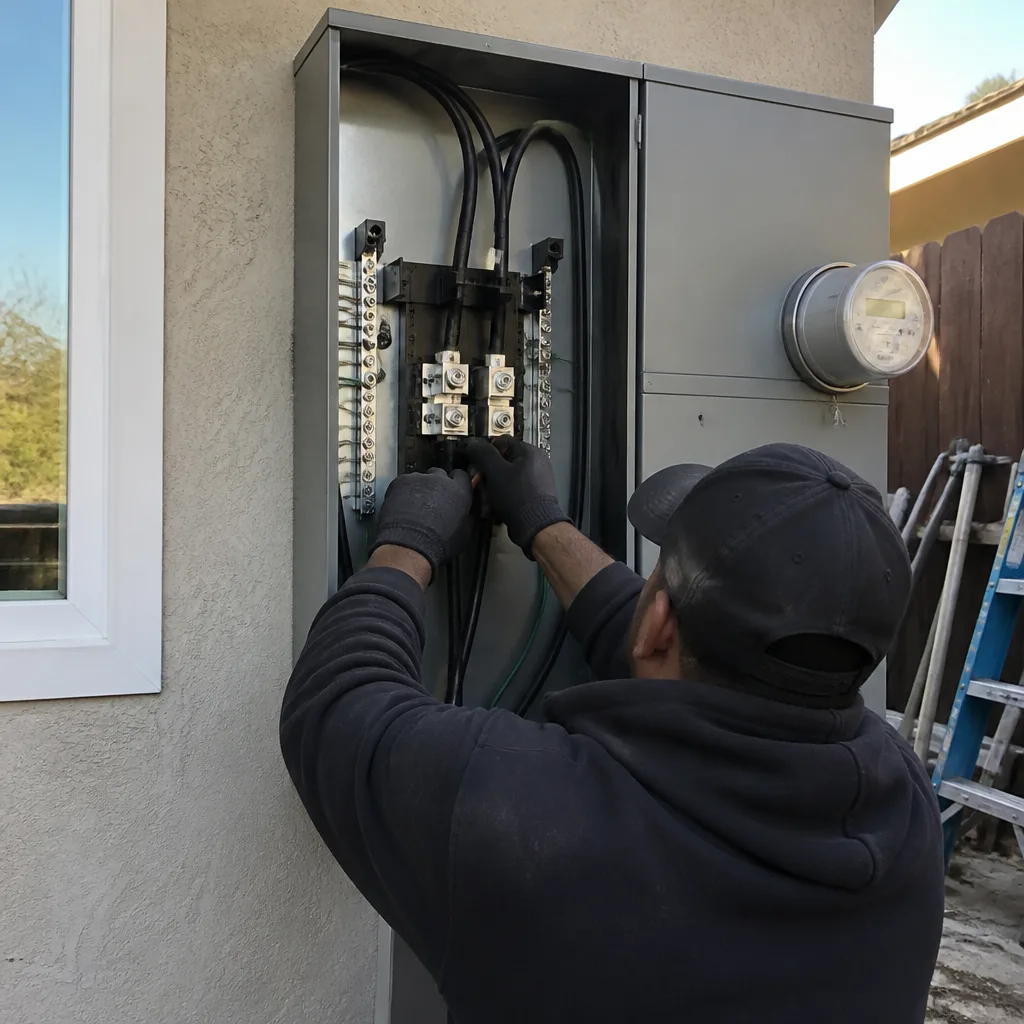
Any burning smell near an outlet or switch in a Tustin home built during this window is an emergency, not a service call. Cut power to that circuit at the panel and call an electrician the same day. The three warning signs specific to aluminum wiring:
- Warm outlet or switch plate: Plates should never be warm to the touch. Any warmth means resistance at the connection inside the box.
- Flickering lights not related to an appliance cycling: On a circuit with a motor load – a refrigerator, an AC compressor, a washing machine – some momentary flicker is normal. Constant or random flicker on general lighting circuits is connection instability.
- Two-prong outlets that were never upgraded: Homes built before 1962 in Tustin often lack a ground wire entirely. Two-prong outlets mean no ground path, and surge protectors plugged into adapters provide zero actual protection. This is a real fire and equipment-safety issue, not an inconvenience.
For the 1980s portion of Tustin’s housing stock, one additional warning sign applies: Federal Pacific electrical panels. These panels, widely installed through this period, have a documented history of breaker failure – the breakers don’t trip when they should. If your Tustin home has a Federal Pacific panel, any tripping breaker, buzzing noise, or rust at the panel bottom justifies an immediate professional evaluation. Most insurers now require replacement.
Plumbing Warning Signs: Galvanized Pipes and Hidden Leaks
Tustin homes built before roughly 1975 often still have galvanized steel supply pipes. Galvanized pipe fails from the inside out: the zinc coating erodes, the exposed steel rusts, and the pipe narrows until water barely moves. You can’t see it, and most homeowners discover it in one of two ways – a sudden pressure drop that gets worse over months, or brown water after the first draw of the morning.
Reduced water pressure at a single faucet is usually a clogged aerator. Reduced pressure at every fixture is likely galvanized pipe failure. If you have galvanized supply lines and the pressure has been dropping over a period of months rather than hours, the pipes are closing up. Full replacement is the only real fix, and it’s a good candidate for bundling with a larger remodel since walls and floors will be open anyway.
- Brown or rusty water that clears after a few seconds: Rust inside the pipes, not a supply problem. Indicates the pipe walls are actively corroding.
- Green staining on copper at joints: This is electrolysis from mixed-metal connections, common where copper was patched into a galvanized system without dielectric unions. The connection point will eventually pin-hole leak.
- Water staining on stucco without a crack above it: If the exterior wall shows damp spots but the stucco is crack-free above, suspect a leaking supply line inside the wall cavity. Shut off the main and call a plumber the same day to prevent structural damage.
- A water bill that crept up 20 – 30% with no change in usage: Hidden leak somewhere in the system, commonly a slab leak in Tustin’s post-tension foundations. Slab leaks are a specialized repair and are not DIY territory.
When we plan a kitchen or bath remodel in Tustin, plumbing inspection always runs before we commit to final scope. Uncovering galvanized pipe at the inspection phase changes the budget conversation early, which is far better than finding it mid-demolition.
Room-by-Room Visual Inspection Guide
This is the Tustin-specific inspection sequence we recommend. It takes about 30 minutes for a 2,000-square-foot home and can be done with a flashlight, a pencil, and your phone camera. You’re not diagnosing problems at this stage – you’re generating a baseline so you can detect change over time.
1. Exterior Walls (walk the full perimeter)
- Photograph every crack in the stucco, wide shot first, then close-up. Note whether each crack connects to a horizontal surface above (window, roof edge, trim band).
- Look for efflorescence – white chalky residue – along crack edges and at wall-to-roof intersections.
- Check the soil at the base of the wall. Gaps between soil and foundation, or soil that slopes toward the house rather than away, are drainage problems that become foundation problems.
- Inspect all hose bibs, vents, and utility penetrations for staining or soft stucco around the penetration.
2. Attic (at least once a year, before and after rain season)
- Use a flashlight. Look for dark water staining on the underside of the roof deck, especially around penetrations and along the roof-to-wall intersections.
- Check the insulation. Wet or compressed insulation loses its thermal value and indicates a leak somewhere above.
- Look for rodent activity. Tustin’s hillside and older neighborhoods have healthy rat populations. Torn insulation, droppings, or nesting materials mean entry points that also let in water.
3. Interior Walls and Ceilings
- Walk every room. Look for cracks that mirror the exterior pattern – this confirms movement through the structure.
- Shine a light raking across the ceiling plane. Small shadowed bulges indicate water pooling above the drywall. A bulge in the ceiling is actively holding water.
- Check around every window and door, top and bottom corners. These are the highest-stress points on any wall and where structural cracks appear first.
4. Kitchens and Bathrooms
- Open the cabinet under every sink. Look for water staining on the cabinet floor, rust on the hinge hardware, or warped cabinet backs – all signs of a slow supply or drain leak.
- Press gently on the cabinet floor with your hand. Soft or spongy material means the leak has been active and has already rotted the wood.
- Check the caulk line around the bathroom tub and shower base. A cracked caulk line is a moisture pathway into the floor system and the most common source of slow hidden water damage in Tustin homes.
5. Garage and Foundation Edge
- Walk the exposed foundation edge in the garage. Look for vertical cracks, diagonal cracks, and any offset – where one side of the crack is higher than the other.
- Check the post-tension cable ends. These are the round metal anchor points embedded in the slab edge. Rusted, popped, or missing cable end caps indicate water penetrating the slab at the cable path. In a post-tension slab, cable corrosion is a structural failure in progress.
- Review stored boxes and stored items. Water staining on boxes, rusted tool surfaces, or musty smell in the garage indicates elevated moisture levels from a hidden source.
Common Mistakes to Avoid
- Ignoring a diagonal crack because it hasn’t changed in years. Cracks are data points, not decorations. A dormant crack today is a crack under different soil conditions next winter. Photograph and measure it annually.
- Caulking a structural crack. Caulk fills the surface but doesn’t address movement below. The crack will return and the caulk will fail. Worse, caulk hides the warning sign while the underlying problem continues to develop.
- Painting over efflorescence. Efflorescence is a symptom of water movement through the wall. Paint seals the surface and traps moisture inside, accelerating rot and mold growth behind the stucco.
- Assuming a flat roof leak is at the visible stain. Water travels along roof structure before it finds the path of least resistance downward. The leak you see on the ceiling can originate ten feet away at a flashing penetration.
- Waiting to replace a galvanized pipe system until it fails completely. Full pipe failure is a emergency repair with drywall, flooring, and mold remediation on top. Planned replacement during a remodel is faster and cheaper.
- Treating every sticking door as a foundation problem. Most Tustin sticking doors are seasonal wood movement. Hiring a foundation specialist for a humidity issue wastes money and doesn’t fix the door.
- Doing a roof inspection only when a leak appears. By the time water shows up inside, the underlayment has been compromised for months. Annual or semi-annual attic checks catch problems at the repair stage, not the replacement stage.
When to Call a Professional
Call a professional immediately if you find any diagonal crack wider than 1/8 inch at a door or window corner, any burning smell near an outlet, any warm switch plate, any ceiling bulge holding water, or any crack in a post-tension cable end cap. These are the warning signs that indicate active structural, electrical, or water intrusion failure. In our experience, Tustin homeowners who catch these early spend thousands less than those who wait for visible damage. If you’re unsure whether something is serious, Ashbury Contractors offers free estimates in Tustin – call (833) 467-4091 and we’ll assess what you’re seeing.
Frequently Asked Questions
Foundation repair in Tustin typically ranges from $8,000 to $35,000 depending on the severity of the movement and whether remediation requires piers, slab jacking, or full section replacement. Hairline crack filling is a $500 – $1,500 cosmetic repair, but structural slab work is a different category entirely. Call (833) 467-4091 for an exact quote once you know what you’re dealing with – estimates are free.
A cosmetic stucco crack is hairline width (under 1/16 inch), runs in a random or vertical pattern, and doesn’t connect to a horizontal surface above that would feed water into it. A structural crack is wider than 1/8 inch, runs diagonally from a door or window corner, and often mirrors itself on interior drywall. The pattern and width matter more than the crack’s age.
Yes. Tustin’s expansive clay soil swells during winter rains and contracts during summer drought, creating seasonal movement stress on post-tension slabs. The combination of concentrated rainfall and long dry stretches accelerates both stucco cracking and roof underlayment wear compared to more temperate California markets.
No. A door that sticks in summer and swings freely in winter is almost always seasonal wood expansion from humidity changes. A door that sticks consistently year-round, gaps diagonally, or has cracks radiating from its top corner points to structural movement and deserves professional assessment.
Post-tension cable end cap corrosion in garage foundation edges. These round metal anchors sit exposed along the slab edge, and when water gets into the cable path, the high-strength steel corrodes. Rusted or popped cable ends indicate a structural failure developing inside the slab itself, and most homeowners never look at them.
Walk the exterior perimeter and check the attic twice a year – once right before rain season in October and once after the last significant rain in April. Tustin’s rain patterns concentrate all the moisture risk into a four-month window, so those two checks catch most problems before they become expensive repairs.
The Bottom Line
Construction warning signs in Tustin homes follow predictable patterns. Diagonal cracks at door and window corners indicate slab movement. Vertical stucco cracks connected to horizontal surfaces indicate moisture intrusion. Lifted tiles and cracked mortar ridges indicate roof underlayment failure, and warm outlets in 1960s and 1970s homes indicate aluminum wiring deterioration. Most of what looks alarming on a Tustin home is normal aging and seasonal movement. The serious problems announce themselves through specific, identifiable signals. Learn to read them, document what you find, and call a professional when a warning sign falls into the active failure category. The cost of an assessment is negligible compared to the cost of ignoring the problem until water finds its way inside.
Contact Ashbury Contractors
If you’ve spotted any of the warning signs in this guide and want a professional assessment, call Ashbury Contractors at (833) 467-4091. We’re a full-scope general contractor serving Tustin and Orange County, handling everything from interior remodels to exterior envelope work – roofing, windows, stucco, fencing with products from Bufftech, Belgard, and Unilock, and hardscaping. One contractor, every trade. We specify the product before we quote the price, so you’ll know exactly what you’re getting and why. Schedule your free estimate today.
Written by the team at Ashbury Contractors, serving Tustin since 2014.
See the difference
 Before
 After
 Before
 After
 Before
 After